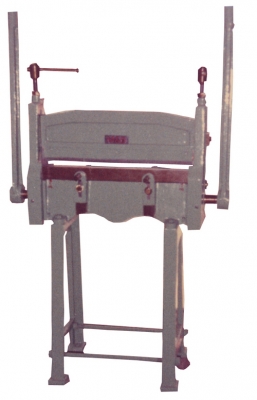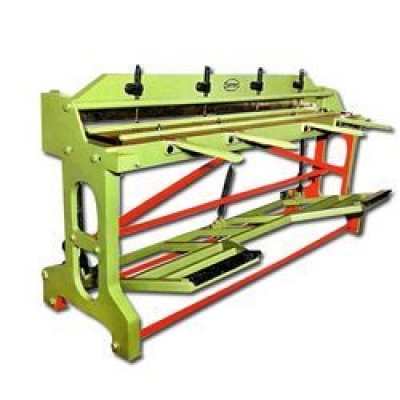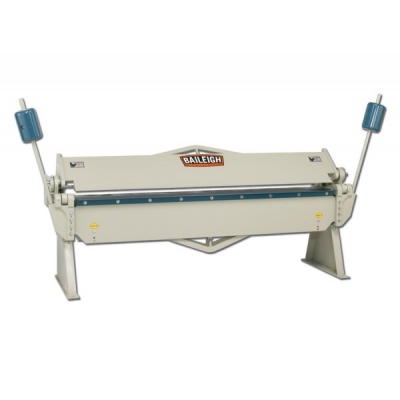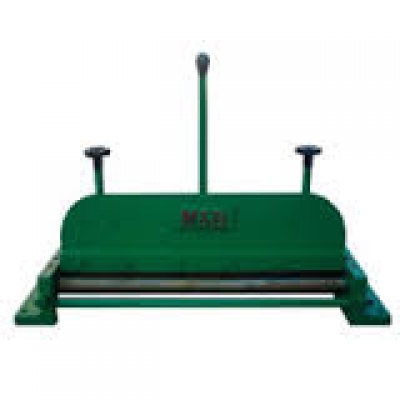
Universal Combination bending brakes represent a modern departure from the old conventional hand brake design. They are not limited to straight bending and box and pan work alone, but will accommodate inside bending, radius forming many other intricate forming operations with special attachments. They are limited in versatility only by the operator's ingenuity. These brakes will form a 1" flange over the entire length in their rated capacity. Heavy duty springs reduce clamping effort and adjustable counterweights reduce bending effort. The upper beam may be moved directly to the rear either 6 or 8 inches to accommodate box fingers and special forming attachments. The normal maximum opening between the upper beam and the lower beam is 1.3/4 " and may be increased to 4" to accept box and pan fingers. When the apron angle iron work support is removed, brake capacity is reduced by 2 gauges. When the apron angle iron work support and apron filler plates are removed, brake capacity is reduced by 4 gauges. When both are removed , 1/4" reverse bends may be made except on 8 foot and 10 foot, 12 foot gauge brakes only 3/8" reverse bends may be made. When bending stainless steel brake capacity is reduced 4 gauges for both straight and finger bending. The Use Of Special And Standard Blades : Caution : Do not form Wire, Nail, Rope or Pipe in these Brakes. Showing section of machine with standard bar and fingers. Note position of folding axis which is constant, no matter what bend is being formed. Metal is in position after a simple right angle bend. For this operation, making small radius bends, the folding beam is lowered in the side arms and the metal clamped in the normal way. When folding beam is raised, the gap between the nose of the folding blade and the face of the folding beam allows a rounded bend to be made. Showing how small return bends can be formed using a specially stepped bar. Such a bar is useful for moulding work. The folding beam lifts high enough to allow that part of the metal on the inside of the beam to be withdrawn over the bar. Narrow return bends can also be formed by substituting the narrow auxiliary blade supplied, for the angle blade, giving a smaller thickness to the folding beam. Figure - 3 Brake will form a one inch flange at rated capacity its entire length with the Apron Filler Plate (101) and Apron Work Support (104) in place. (See fig. 3) Removal of Apron Work support (104), reduces brake capacity by 2 gauges. Removal of both Apron Work support (104) and the Apron Filler Plate (101) reduces brake capacity by 4 gauges. Figure - 4 Minimum Reverse Bends : Removal of both Apron Work support and the Apron Filler Plate permits 1/4" reverse bends to be made on all brakes except Models 8ft. x 10ft. On these two models the minimum reverse bend is 3/8" (See Fig. 4) Figure - 5 To Flatten Seam With Apron : Bend metal over brake nose to 45". Remove maetal. Place against upper beam and flattern
Universal Combination bending brakes represent a modern departure from the old conventional hand brake design. They are not limited to straight bending and box and pan work alone, but will accommodate inside bending, radius forming many other intricate forming operations with special attachments. They are limited in versatility only by the operator's ingenuity.Bulk discounts on tender quantities for ITIs and polytechnics.
Approved vendor for MOE, World Bank and AfDB-funded projects.
On-site commissioning and operator training for turnkey supply.
Shipped to 60+ countries on FOB / CIF / DDP terms.
ELAB Engineering is one of India's leading manufacturers, exporters and authorised suppliers of Universal Edging & Bending Machine, supplying engineering laboratories, polytechnics, ITIs, university departments and Ministry of Education programmes for over twenty-five years. Each unit ships with the complete tender-grade documentation pack — ISO 9001 quality certificate, CE conformity declaration, RoHS compliance statement, country-of-origin certificate and authorised dealer letter — included as standard, not as an extra.
We supply Universal Edging & Bending Machine against Government of India e-procurement tenders (GeM, CPPP, e-Procurement portals of state DTEs and DGT), bilateral and multilateral donor-funded contracts (World Bank STEP, AfDB e-procurement, JICA, KfW, USAID), Ministry of Education and Ministry of Skill Development bulk procurement programmes, polytechnic and ITI modernisation schemes, university research grants, AICTE-MODROBS / RPS / MARGDARSHAN funded laboratory upgrades, NSQF-aligned skills development centre projects, and direct commercial procurements by engineering colleges and TVET institutions.
Our standard tender supply scope for Universal Edging & Bending Machine covers manufacturing to specification, factory acceptance testing, pre-shipment inspection (SGS / Bureau Veritas / Intertek where required by the tender), export-grade marine packaging, FOB / CIF / DDP shipping at the buyer's preference, marine insurance, destination customs clearance liaison, inland transportation to the institution's site, on-site installation by qualified service engineers, commissioning with the institution's faculty, hands-on operator training and a written handover with a 12-month manufacturing-defect warranty.
Our Universal Edging & Bending Machine is currently in service across more than sixty countries. The most common buyer profiles are: Ministry of Education (MOE) and Ministry of Skill Development teams running national TVET strengthening programmes; donor-funded project implementation units — World Bank STEP, AfDB skills programmes, EU technical co-operation; engineering colleges procuring laboratory equipment for AICTE-mandated curriculum modules; polytechnic institutes equipping diploma-level workshops; ITIs modernising trade-specific labs under DGT and state DTEs; private engineering universities with NAAC-accreditation laboratory requirements; vocational training centres aligned to NSQF skill levels 4–7; and corporate skill-development partners running CSR-funded technical training.
Manufacturer-direct pricing applies on tender-scale quantities of Universal Edging & Bending Machine. Volume pricing tiers are extended at 10+ unit, 25+ unit and 50+ unit thresholds, with bespoke pricing on consignments above 100 units. On donor-funded procurements we provide separate price ladders for FOB Mumbai, CIF destination port and DDP institution gate as requested. Indicative landed cost calculations — including freight, marine insurance, destination customs and inland delivery — are shared with every formal quotation so the procurement evaluator can compare bids on a like-for-like total cost basis.
Standard ex-works lead time for Universal Edging & Bending Machine is two to three weeks for stock configurations and four to six weeks for customised configurations (voltage / frequency variants, specification customisations, language localisation, sponsoring-agency branding overlays). Sea-freight transit adds a further three to six weeks depending on destination port. We accept Letter of Credit (sight LC, 30/60/90-day usance LC), RTGS / NEFT for domestic supply, and milestone-based payments structured against tender progress for turnkey contracts. Standard warranty is twelve months from the date of installation against manufacturing defects, with optional Annual Maintenance Contract (AMC) renewals covering preventive maintenance, calibration, replacement of consumables and remote technical support.
The most common reason a tender bid for engineering laboratory equipment is rejected is not price — it is documentation. A missing certificate, a country-of-origin that does not match, a sample that fails on a single specification, or an authorised dealer letter not on the manufacturer's letterhead. As experienced Engineering Lab Equipment Suppliers and Skill Training TVET Lab Equipment Manufacturers for bulk Tender supply, we treat the documentation pack as a first-class deliverable. Our tender desk maintains a pre-built compliance library matched to World Bank STEP, AfDB e-procurement, GeM and bilateral donor templates — so the documentation is the easiest part of the bid, not the hardest.
Beyond paperwork, the discipline of factory acceptance testing before shipment, marine-grade export packaging, and on-site commissioning by our own service engineers (rather than freight-forwarder hand-offs) means the equipment that arrives at the institution is the equipment that was tendered for — with no surprises at uncrating. This consistency is why we are repeatedly shortlisted for repeat orders by institutions and donor agencies on subsequent tender rounds.
Email your tender document, Bill of Quantities or simple specification list to orders@elabengineering.com or call +91-9811375383. Our tender desk responds within forty-eight hours with itemised pricing, the certifications matrix, country-of-origin and shipping options bundled into a single proposal — in the format your evaluation committee expects.
Curriculum-aligned use cases for engineering colleges, polytechnics, ITIs and TVET training centres.
Aligned to AICTE / UGC engineering syllabus modules, covering both theory demonstration and practical experimentation outcomes.
Mapped to NSQF polytechnic and ITI diploma practical schedules — designed for hands-on student experimentation, not just demonstration.
Configured for competency-based assessment with clear pass/fail criteria — ready for direct deployment in skill-development programmes.
The complete documentation stack a procurement evaluator expects to find in the box — standard, not extras.
ISO 9001, ISO 14001, CE and RoHS declarations
Country-of-origin certificate & authorised dealer letter
NABL / ISO 17025 traceable calibration certificates
Operating manuals, lab worksheets & safety instructions
Manufacturing-defect warranty with optional AMC extension
FOB / CIF / DDP terms with customs & insurance handling
On-site installation & commissioning by qualified engineers
Hands-on operator training & lab manual handover
When specifying Universal Edging & Bending Machine for an engineering college, polytechnic or TVET institution, the procurement officer's checklist looks slightly different to the lecturer's wishlist. The lecturer wants the equipment that demonstrates the principle most clearly. The procurement officer wants the equipment that survives evaluation, customs, installation and the first year of student use.
As experienced Engineering Lab Equipment Suppliers we treat both audiences as customers. The technical specification needs to satisfy the academic requirement — but the documentation, packaging, freight and warranty pack also need to satisfy the auditor. Both happen on the same shipment.
For Skill Training TVET Lab Equipment Manufacturers for bulk Tender supply, the additional layer is donor compliance: World Bank STEP procedures, AfDB e-procurement standards, and bilateral donor templates each have specific certification expectations. Our tender desk maintains a pre-built compliance library matched to these formats.
Get manufacturer-direct pricing, technical datasheets and shipping schedules within 24 hours.
Request Bulk Quote